
The Space to Show Up: How Paid Leave Helped One Dad Become the Father He Wanted to Be
Ethan Franks does not consider himself a political person. He is a software developer, a guitarist, a father of three, and a former construction worker who spent years talking with coworkers on job sites about the kind of work culture America could be building instead of the one we have. He is informal, funny, and disarmingly honest about the parts of himself that are still a work in progress. He is also one of a remarkably small number of fathers in Kansas who have experienced 12 weeks of paid parental leave.
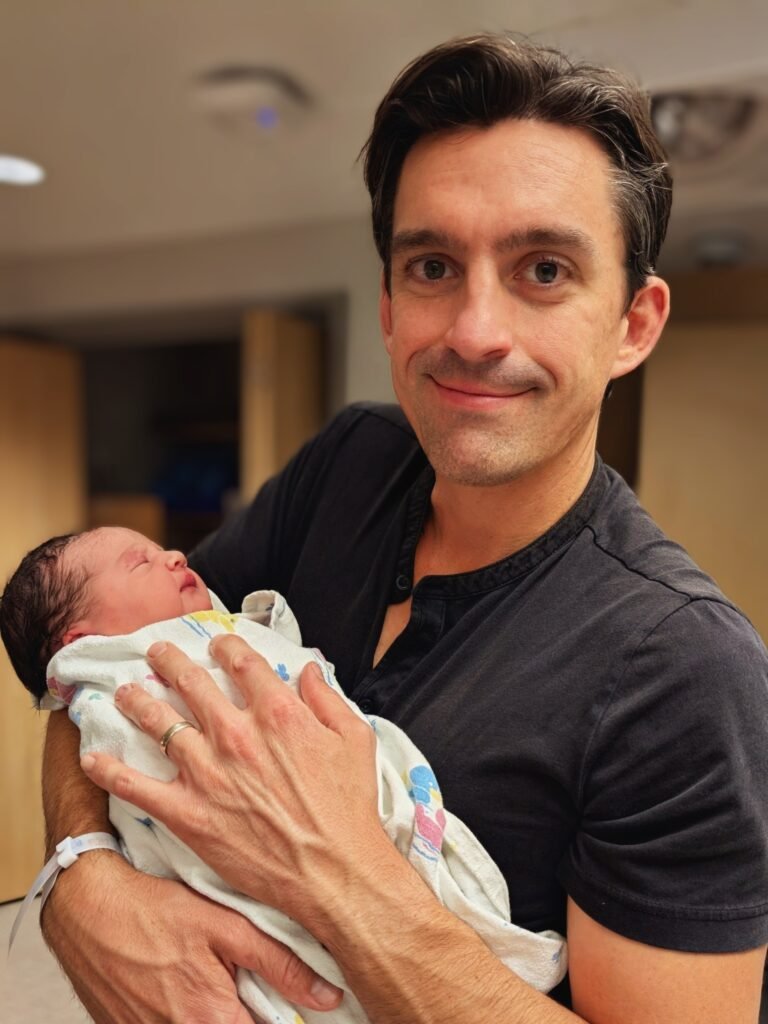
Ethan’s story is about what becomes possible when we give people the margin to be human.
When Ethan was 16, his parents passed away. He and his brother had, after that, people: family members and a village who made room for them and showed up when they could. He speaks about that period of his life with gratitude. The loss he endured still shows up in the songs he writes or in how fiercely he loves his kids, or the urgency he feels when he talks about what fathers need to be present.
Ethan settled in Wichita, studied guitar at Friends University, spent over a decade in construction, and eventually taught himself software development. He switched careers multiple times before landing at Udacity, an online education technology company, where he works today as a software developer.
None of that background came packaged with a generous benefits plan.
With his oldest daughter, Fiona, Ethan was an hourly employee doing landscape construction. When she was born in December, he was lucky that it snowed and a few forced days off work gave him about two weeks with his new baby, unpaid. “I felt lucky,” he said. “But I also wasn’t getting paid during that time, which is obviously stressful.”
His son Rainier arrived in March 2020, the same week Kansas shut down for COVID-19. The hospital was scrambling to establish new protocols in real time. Ethan and his wife, Angela, were navigating a newborn, a two-and-a-half-year-old, and the first weeks of a global pandemic all at once. “That was the most stressful season of my life,” he said. He barely took time off at all.
As one can imagine, the lack of support during those early weeks, paired with the absence of a steady paycheck and the weight of everything falling at once, made it harder.
Ethan carries that history with him.
Five months before his third daughter, Margot, was born, Ethan started a new job at Udacity. Technically, he was a month short of the six months required to qualify for the company’s 12-week paid parental leave benefit. He asked his direct manager about it.
“‘Oh, I’m going to make sure that we get that for you,'” Ethan recalled his manager saying. “Culture is everything in a company. The fact that my boss was willing to go to bat for me when I was a month shy of getting it was huge.”
That exchange–a manager choosing to advocate for his employee’s time with his newborn rather than citing policy–became the centerpiece of how Ethan understands what paid leave actually requires to function. The benefit existed on paper, and he wishes that more places had a workplace culture that treated it as something worth protecting.
Margot was born in November. Ethan took the first six weeks of his leave immediately, with three more weeks planned for the following June and the final three weeks after that. The flexibility to split the time gave him something invaluable: the ability to be present in two different critical windows of his daughter’s early life.
During those first six weeks, Ethan’s primary job was the other two kids.
The common misconception about parental leave is that it is essentially an extended vacation. The gap between that assumption and the reality of what those weeks actually involve is something Ethan wants people to understand. “It is work,” he said. “And that’s the benefit of me being home for those six weeks: Ang and I can split that load.”
The results were measurable in a way that mattered. Primarily, Angela had the least amount of postpartum depression of any of their three births. “I think a big part of that is because she had more support,” Ethan said. “And just the stability of knowing, ‘oh, we have a paycheck coming.’ Even though Ethan’s at home, we didn’t have that with our first two kids.”
He paused. “Babies are expensive. And when there’s no paycheck, and the clock is ticking, it’s just spending money.”
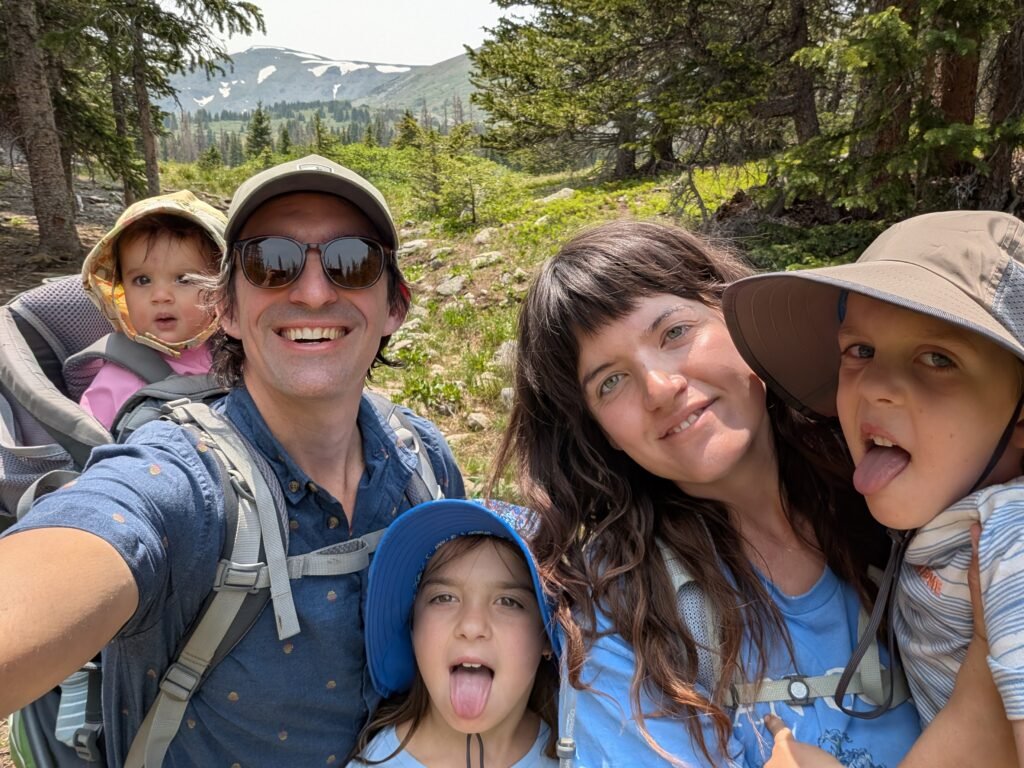
At six months old, Margot is, by her father’s account, unmistakably his.
“It’s been really evident that she is already very attached to me,” Ethan said. “With the other two, I think it took a few months, because you’re there for the evenings, or in the mornings, and most days, and of course they love me, and I love them. But having that dedicated time to just be there and hold her, to be up in the night with her, it’s a huge benefit. To Angela, and to Margot, and to me.”
This is what he wants people to hear, especially men, especially the ones who came up the way he did–on job sites where overtime was a point of pride and time off was something you had to justify. “It is a reasonable thing to take more than just the bare minimum of time off to be with your newborn, even as a father,” he said.
A culture that conflates hustle with worth can, he suggested, give men a socially acceptable exit from the harder emotional work of parenting. “It’s easier to go to work than it is to take care of a kid sometimes, emotionally,” he said. “You can sort of be absolved of responsibility. I have to go to work. But that’s not an either/or.”
Fatherhood, he said, requires showing up. It is not enough to just be employed. And for Ethan, the most important part of paid leave is what he called margin. It is a word he uses carefully, because he means something specific by it.
“Margin is the opposite of the typical American life,” he said. “Hustle culture is the work side of things. But there’s also this expectation that your kid has to be in every sport, do every extracurricular, be exceptional in every way. And those aren’t bad things in themselves. But when it means you and your kids never have an hour or even a weekend where nothing’s happening, and you can all just be human beings together, that’s when it becomes detrimental.”
He spoke from experience that runs deeper than a single parental leave policy. He has navigated depression, the grief of losing his parents young, and the cascading stress of trying to launch a new career while his family grew. What paid leave gave him, he said, was the space to actually be present and not just physically in the house, but regulated, available, capable of showing up.
“I don’t think people realize how important margin is in their lives,” he said. “And that’s what this PTO allowed me to have. Margin.”

He was clear about his lesson from all of this: the American work culture that expects parents to return immediately after a child is born is harmful. And because the incentive structure will not correct for it on its own, legislation and policy change matter. “We have every right to fight for, ask for, and defend our time with our children,” he said. “Everything starts at home. If we want a society that functions, we have to have parents who are well-regulated, emotionally present, and connected with their kids.”
Ethan Franks is not the loudest voice in any room. He described himself as someone who tries not to overshare, who finds elevator pitches excruciating, who would rather have a real conversation with someone than deliver a polished message. But when it came to this, to what it meant to hold his daughter through six weeks of newborn chaos without the clock ticking down on an empty bank account, to watch his wife move through postpartum with more ease than she ever had before, he was clear.
“If even one person, if one father, comes away from this with the realization that it’s okay to ask for margin in your life,” he said, “that’s everything.”
And for those who read his story wondering what they can do, Ethan’s answer is simple, and a little impatient. Vote. Know the issues. Show up. The benefits exist somewhere. The culture to make them possible is what we have to build together.
###