Minding the Gap: How One Kansas Farmer is Closing the Loop on Food Waste
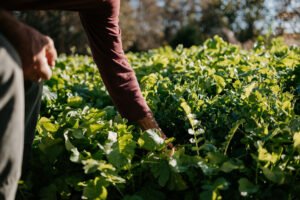
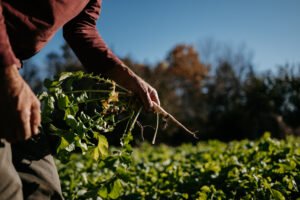
At four o’clock on a Thursday afternoon, Robert Hickerson lifts the lid on a cooler at the Lawrence Farmers Market; the greens inside were still rooted in the ground four hours earlier. Only two or three places in Lawrence offer produce that fresh, and he knows it. For Robert, the few hours between harvest and his customers’ hands is his whole philosophy. “The food never gets better the farther away from the farmer it gets,” he says. The closer you stand to the soil it came from, the better off you are.
The distance between people and the food that nourishes them, and the even wider distance between people and any real sense of where good food comes from – is the gap Robert has spent his second act trying to close. He doesn’t frame it as a fight. “We’re not the resistance, we’re the flow,” he says of farmers who grow for good food, good health, and community. “This is how a good community is built and maintained, sustained and grown.” He’s pushing back against the noise and division that fill the headlines. His job is to represent the flow. The quieter, older logic of how living things actually sustain one another.
That logic, for Robert, runs underground. He is endlessly fascinated by the parts of the natural world most people never see: the soil, the microbes, the fungi, the unglamorous web of organisms that makes human life possible in the first place. Human beings, he likes to point out, are nowhere near the most populous form of life on the planet. He tries to look at the world from outside a strictly human point of view. He notices how nature keeps working beyond us and without us, and he keeps coming to the same conclusion: the way nature works is probably the way people ought to work too.
Good dirt
His fascination began with a handful of dirt. Robert grew up where there were always tomatoes and green beans in the backyard and with a mother who canned whatever the garden produced. Food that came straight from the ground was how the household ran. Then, in fifth grade, a teacher asked him to bring a soil sample to school. She looked at what he handed her and said, “This is really good dirt.” It was a small remark, but it rearranged something in him. He had never considered that dirt could be good or bad, or that there was any difference between plain dirt and living soil. From that day on, the hunt for “good dirt” became an obsession. He’s never stopped chasing it.
The obsession had to wait, though, through an entire first career. For years, Robert worked at the University of Kansas in education and research, serving as a database manager. A job far from dirt and a farmers market cooler. By his own admission, he’d rather work quietly than talk himself up. “I’m usually a little bit more humble than talking about myself like that,” he says, almost apologizing for naming his own gifts. But he’s clear about how much of that earlier life he carried into this one. He has a long-range, big-picture mind. The kind that connects dots no one else has thought to connect. “I love to find available materials and build something that I need,” he says, whether that means rummaging through his own toolbox and junk pile or scanning his community for the right people and parts to assemble into something new. Database management and soil management, it turns out, both reward a person who can see how separate pieces fit into a working whole.
Once he turned to farming full time, he was surprised how few other folks were doing the same. The community of people devoted to soil health, organic growing, and real food was very small in his corner of the state. For a while, that left him isolated and a little puzzled. To him, this is exactly what more people should be doing. But the isolation didn’t send him inward; it pointed him outward. If there weren’t enough growers and believers yet, then part of the job was to go make more of them.
The Soil Magician
So Robert became a connector and a teacher. He founded a book club called Mad Science Monday, built on a simple premise: learn something, then do something about it. The club is one of the clearest windows into what drives him, a conviction that knowledge is meant to be shared and acted on, not hoarded, and that an appetite for learning is contagious. He hopes, he says, to infect the people around him with the same zest for life he carries.
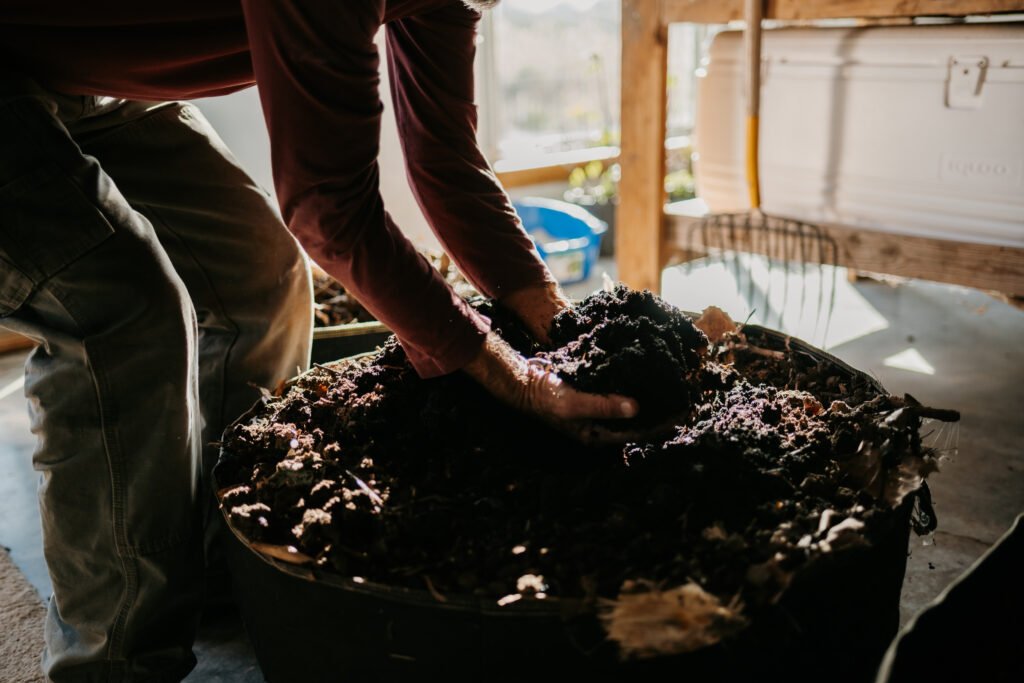
Robert brings that same instinct to the market. When he first started selling downtown, he was a brand-new vendor with a sales background and a problem to solve: how to make a stranger remember him. His answer was theater. He hauled in a bucket of compost and a container of live worms alongside his produce, and for anyone who wandered past, he performed a magic trick. Compost, then worms, then fresh food, the whole cycle of life in one quick demonstration. It was a little gimmicky, and he knew it, but it worked. People remembered the soil magician, and once they remembered him, he could start teaching them what he actually cared about. The produce was the draw; the lesson about soil was the point.
His sense of civic duty runs deep as well. Robert sits on the long-range steering committee for the Lawrence Farmers Market, the oldest continually running market in Kansas, which recently secured city commission approval to pursue a permanent home. This is the kind of unglamorous work that decides whether a community asset survives. “When something needs to be done,” he says, “you’ve got to step up.” He hopes his presence on that committee models the same for everyone watching.
Not all of him lives in the soil, though. Robert has also been a musician his entire life. He’s played professionally over the years, but these days he plays purely for the joy of it and the community that gathers around it. The man who can endlessly lecture on fungal networks and database management also likes making music with other people. It’s in line with everything else about him: the same openness, the same belief that good things are meant to be shared.
A gift for people
Ask Robert what he cares about most, and there’s no hesitation: high-quality, nutritious food, and getting it to the people who have the hardest time reaching it. “Everything about food thrills me,” he says – growing it, cooking it, eating it. But what truly moves him is watching someone else experience that thrill. There’s a particular moment he lives for: opening that cooler and seeing a person’s eyes light up at the beautiful food inside. Kevin, who manages the market at Cottin’s Hardware, has a young son, four or five years old, who loves raw spinach. So any week Robert has spinach to spare, that child goes home with a bag. “That’s the behavior I want to support,” he says.
Early in his time at the downtown market, a woman brought a group of six or seven girls, twelve to fourteen years old, on a rare outing from juvenile detention. Robert gave them the full magic show, and the girls met him with exactly the wall of teenage indifference you’d expect. He figured he hadn’t reached them at all. Then, months later, the woman came back and pressed a note into his hands. Every one of those girls had written something down about what the visit had meant, or what they remembered. He had been certain he’d failed to connect, but he had been wrong. The memory still catches in his throat. “Don’t ever give up on people,” he says. “You never know who you’re influencing.” The lesson goes two ways for him: be generous with strangers, and be careful too, because someone is always watching.
The advocate
Generosity is the engine under his advocacy, and Robert is an unmistakable advocate. He worries, openly, about a culture that has grown a little too willing to trade nourishment for speed. One will reach for whatever is fastest rather than show up at a market on a Thursday afternoon for greens picked that morning. But he frames it less as a grievance than as an invitation. The best thing about not being in a hurry, he points out, is wonderfully simple: “It’s a lot easier to be nice to somebody.” Slow down, he suggests, and you don’t just eat better, you treat people better..
Robert is equally candid about the larger forces shaping how people eat. He sees a food system increasingly defined by corporations and consolidation, and he remembers something his father told him long ago, about cattle that would come eat right out of his hand: “If you control an animal’s food, you control an animal.” Robert sees the same principle creeping into how people are fed. And yet he is no purist chasing an impossible ideal. He knows direct-to-market farming can’t feed three hundred million people on its own, and that not everyone can drive to a farm stand every day of the week. He doesn’t want to overturn the whole system, but to provide the opportunity for more people to have a real, attainable choice. Integrity, accountability, and community are the words he comes back to when asked what guides him, and he means them less as slogans and more as the daily terms of the work.
He carries that case all the way to the people who control public money. Real change, Robert argues, starts at the grassroots and compounds from there.. When tax dollars flow to an absentee rancher sitting on two thousand acres he hasn’t laid eyes on in years, they enrich exactly one person. When they’re invested at the local level or in family farms, every dollar circles straight back into the community they live in, feeds their neighbors, and helps seed the next season of growers. “More investment into the soil yields more at harvest time,” he says, a line that doubles as economics. The small farmers and urban growers raising food, he believes, deserve a fair, more proportionate share of the support that currently flows right past them.
Minding the gap
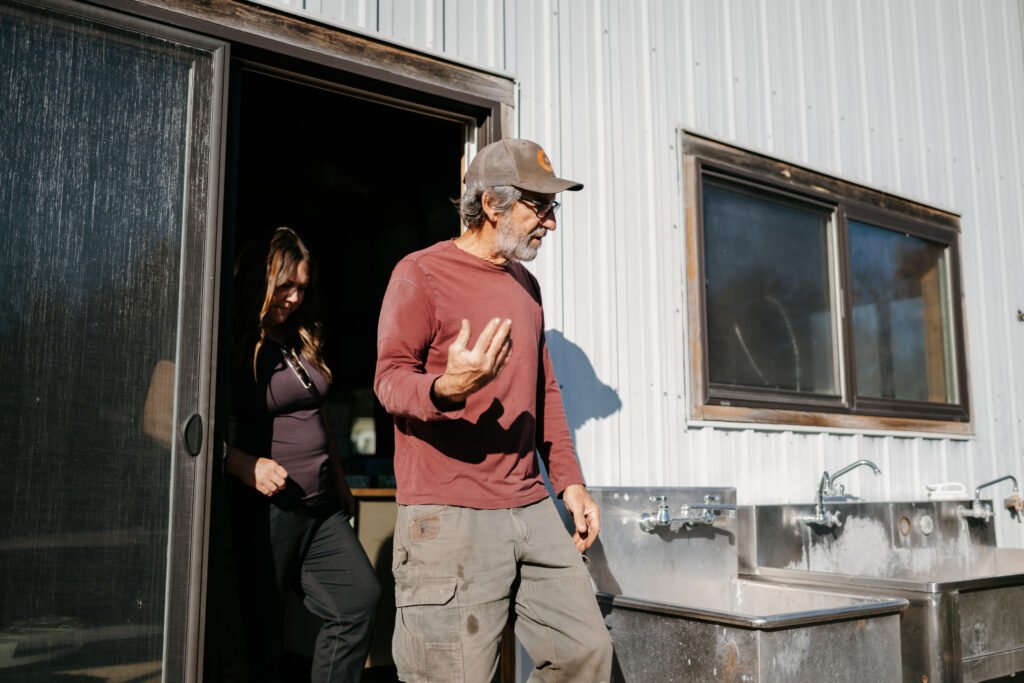
It all comes back to the gap. Good, nutritious food is harder to reach than it should be, and the knowledge of how to grow it keeps drifting further away from everyday life. Robert Hickerson has built his second act around minding that gap. Narrowing it one cooler of just-picked greens, one magic trick, one bag of spinach, one note from a kid who wasn’t supposed to care, one neighbor at a time. He’d be the first to wave off any praise for it. But in a world moving faster and farther from its own roots, a man this devoted to the few inches of living soil beneath our feet, and to the people standing on it, is doing something radical. He is reminding his community that the flow is still there, still feeding everyone, if only they’ll slow down long enough to reach for it.
###