
A Kansas Nonprofit CEO Shares How a Special Preschool Prepares Vulnerable Students for Kindergarten
For more than fifteen years, Kyle Roggenkamp (42) has walked into Lawrence’s Ballard Center knowing he is entering not just his workplace but a community built on accountability and intentionality. He has held nearly every job there, from facilities manager to director of family stabilization, and now as CEO. He takes pride in being a “different type of CEO,” building honest, “warts and all” relationships,” a transparency he believes essential for a nonprofit that is 60% privately funded.
Kyle moved to Lawrence over twenty years ago, transferring to KU “fresh out of homelessness.” He credits Ballard for taking his “pain and turn[ing] it into purpose.” With joy and a smile, he describes his wife, Lisa, as the “center of our universe…who keeps everything going” for their three boys.
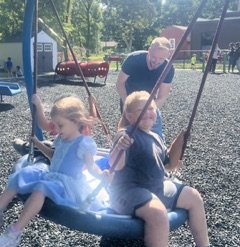
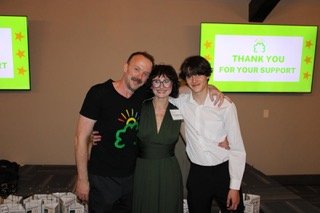
Preparing Children by Stabilizing Families
Ballard began as a preschool in 1964 with a simple but transformational mission: prepare young children for public school. Its goal has always been clear: if children enter kindergarten socially, emotionally, and cognitively ready, then “the sky’s the limit,” regardless of income or circumstance. Kyle says, “if a child feels safe and connected, they’re much more likely to advance in their development. [Then they’ll be able to] know all the letters and numbers and how to spell their names when they go to kindergarten.”
School readiness does not happen in isolation; children cannot grow academically when their home life is marked by instability, so Ballard expanded its focus to include stability of the family. They paired early education with wraparound support: rent and utility assistance, various therapies, and a community pantry for food, clothes, and other essentials. Today, 48 families have children enrolled in the center, but more than 10,000 people in the wider community receive assistance every year. Ballard’s connection to the school district continues after children leave pre-K. Teachers at a local elementary school praise Ballard for laying the foundation of safety and connection. Kyle explains, “[we] can’t fix everything by five [years old]…it’s really an [ongoing] partnership.”
The Emotional Labor of Early Childhood Education
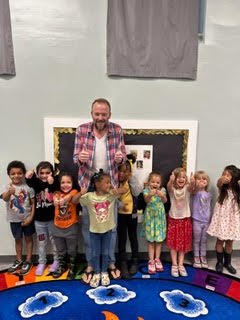
The preschool program employs ten teachers in four classrooms. Each Monday morning, teachers see children struggling to regulate their emotions after a weekend without the structure and predictability of school. Staff patiently help each child readjust and reconnect; teachers also serve as mandated reporters, sometimes uncovering the first signs of abuse or neglect. As Kyle explains, it takes continuous work to help some students feel safe at school, which takes an emotional and physical toll.
Ballard shows up for its teachers with the same passion those teachers show up for their students. Kyle repeatedly returns to praising these educators, reminding us that statewide average pay for early childhood educators is still only $13 an hour. For the past five years, he and his colleagues have raised funds for a “living wage initiative” for their teachers and, after intense groundwork, announced a nearly unheard-of increase to $20 per hour in 2026: “[our teachers] are doing some of the most beautiful, important work in our communities in Kansas for very low wages… They’re all heroes.”
When Safety Changes Everything
The staff know what tragic outcomes can occur. “We’ve had to help bury children that went to the Ballard Center,” he states with resolve. The light that cuts through the hardest days is knowing when a child can live in a home “where the water is turned on, the lights are turned on…there is not a three-day notice on the door…food is in the fridge.” He speaks of the impact for the parents as well; when those monetary stressors are removed or reduced, parents can be more present and engaged in their children’s development. “Everything we do here is trying to get those families out of that survival mode,” Kyle shares.
One story Kyle notes is that of two toddler sisters, who came to Ballard after suffering severe abuse from their mother. One girl was sent to Children’s Mercy with broken arms and patches of hair torn out. Ballard worked with their grandmother and their father, who completed therapy and worked with services to regain custody. Five years later, Kyle met them walking home from school — happy, stable, and proud to be with their dad and new puppy. Both girls are “freaking thriving” at their elementary school, Kyle exclaims.
Innovation Born of Necessity
Seeing success and gratitude from families sustains the team, yet the work remains difficult, especially as statewide decisions — like Kansas declining Medicaid expansion or the recent uncertainty of SNAP benefits — place increasing pressure: “The work keeps getting harder, the resources keep getting smaller, and the need keeps growing.”
Ballard, however, pushes on. In January 2026, the center will launch its 7% Tuition Model, ensuring no family pays more than seven percent of their income for childcare, the federal definition of affordability. For a family earning $40,000, that shift means childcare costs will plummet from $1,100 to $200 per month. Ballard is also launching health insurance for its educators, all without government funding. Kyle describes these changes as years in the making: a combination of intentional planning, disciplined budgeting, and a community willing to invest.
A Public Investment Hiding in Plain Sight
These initiatives show what is possible, but it raises the question of why. Why is the Ballard story unique when the state has the power to scale? Kansas, like other states, relies on nonprofits to shoulder responsibilities that should be publicly supported. Why, in the richest country in the world, don’t all children have access to a safe, quality preschool education? Why, in a country that is supposed to value children, family, education, access for all to food and safety, is Ballard unique?
Kyle wishes policymakers understood that stability in early childhood is not charity; it is a public investment with lifelong return. He states, albeit hyperbolically, that any investment in children “will pay for [any] investment a million times over.” Beyond the moral and ethical cost, without care, the fiscal cost simply shows up later in negative outcomes and lost potential.
Research provides data that echo his passion. The White House’s 2015 The Economics of Early Childhood Investments report finds that for every $1 spent, society saves $3–$6; UNESCO reports such investment yields a 13% return by way of improved health, economic, and social outcomes. The 2024 Annual Report of Kansas Children’s Cabinet and Trust Fund shows that spending on early-childhood services alone saved the state nearly $22 million from avoidance of foster-care placements and other intervention costs, which is an 8% ROI: it also reduced the likelihood of children being removed from the home by 28%.
Additionally, the RAND Corporation, among others, found that high-quality early childhood programs produce significant crime-reduction effects which can account for 50–70% of the total public savings; some programs reduce crime enough to yield $4–$10 in public savings per $1 spent.
Accountability to the Next Generation
Kyle argues that someone must keep reminding the community that “we are all accountable to these children,” a truth rooted in his own experience. He describes spending decades as “the most angry person you will ever meet.” As he puts it, “there’s nothing more dangerous than a smart, talented, isolated, angry young man.” He knows he is “one of the lucky ones.”
“Your love for your community is a reflection of your love for yourself.”
For Kyle, the greatest honor is being a conduit for children and families. Accountability, intentionality, and discipline guide his leadership. “Your love for your community is a reflection of your love for yourself,” he says, and his life, from homelessness to CEO, reflects that belief. His work is challenging, but he wants people to know it is also beautiful. When people hear his story, Kyle wants them to get involved: vote, donate, learn, contact representatives, show up for their community – just as he and all at Ballard keep doing every day.
###