
We Don’t Have the Option to Wait
“We live on the edge,” said Jane Fergus, whose younger of two children was born with a terminal illness. “Children like Frankie don’t have the option to wait until you ‘figure it out.’”
Fergus and her husband, Fred, began their long journey to save Frankie’s life as soon as he was born. “One of the first things I noticed was he wasn’t breathing right,” Fergus said. The doctors she asked said premature babies often have “periodic breathing.”
“But I felt certain that wasn’t the case. Instinct, I guess.”
Frankie was 30 days old when he had his first surgery. His most critical problem was what Fergus called “breathing-eating” — he did both simultaneously. Doctors believed this was causing his tongue to fall back into his airway. He also still stopped breathing altogether until she or Fred triggered it to restart by physically shifting his body.
At about 4 months old, he went in for “same-day” surgery on December 8; he came out the night before Christmas Eve. Surgeons broke his jaw and inserted a plate with pins extending outside his head. “We turned the pins every day for six months until that bone grew into his jaw,” Fergus said.
It wasn’t helping. “Things were kind of rapidly rolling, snowballing.”
Fergus’s employers offered good health insurance and a culture of support. They arranged for a visit to a renowned Philadelphia children’s hospital, which did a whole buffet of tests.
Then the hard news came. Frankie had had a stroke in utero, and the right side of his brain was dead. In addition, tumors were growing throughout his head and body. The condition was neurofibromatosis (NF1), and they told her he was unlikely ever to walk, talk, or have any abilities beyond those of an infant. He probably had only days or weeks left.
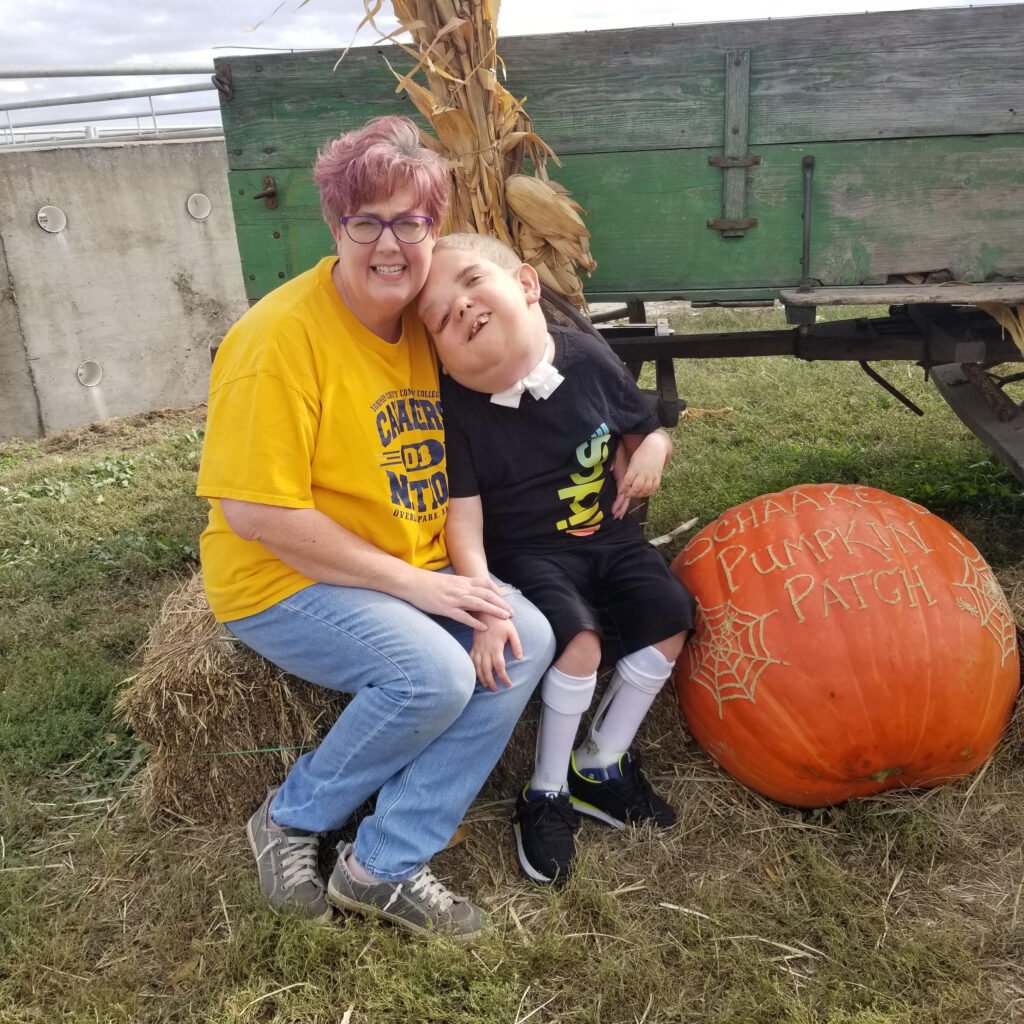
Devastated, the family returned home to Lawrence, Kansas. With their 10-year-old daughter, Savannah, they grieved and prepared for a week, but after a “wonderful” hospice nurse visited them and sensed that they were still unable to accept what was coming, he asked them what they would do if he stopped breathing in the middle of the night: “call 911 or call us?”
“I said, I am always gonna call 911.” The nurse told them they weren’t ready and left.
“But it ignited a fire in me,” Fergus said. “I knew right then and there we had to start fighting back.”
The Battle Begins
First, she had to stop the seizures. She had found a drug widely used in Europe, but not FDA-approved in the U.S. So, she began calling around. “I called the neurologist, ‘can you get me this drug?’ ‘Nope.’ ‘OK bye.’ I called the next one, ‘can you get me this drug?’ ‘Nope.’ OK, bye.’”
She continued until she finally found one willing to try. “We jumped through all the hoops to get a non-FDA medicine over here, and Frankie started that drug on February 14, 2010. He has not had a single seizure since then. We knew that that drug had made a difference.”
Next, “He had to breathe, and he had to eat.” They called health practitioners seeking one who would facilitate a tracheotomy and a feeding tube, a very risky procedure because of complications Frankie had had, the small size of his throat, and the possibility of him suffering a cardiac arrest during the surgery. He was already on oxygen, and it had become more difficult to get him to breathe. “We said, ‘well, he’s gonna die tonight if you don’t do something, so do something.’”
After a tense night of waiting, complete with a chaplain on hand, they were told the procedure had gone well and that he’d been intubated on the first try. Shortly after the surgery, he had his gastronomy tube inserted. “We’d been at the hospital about a month.”
By 2014, Frankie’s airway had shrunk to the width of two dimes stacked and was below the trach tube line. Years earlier, Fergus had read about the work of Dr. Nancy Ratner, who ran a pioneering medical lab in Cincinnati. She stabilized Frankie with a longer tube fitting and, a year later, started him on a new drug, now called Selumatinib.
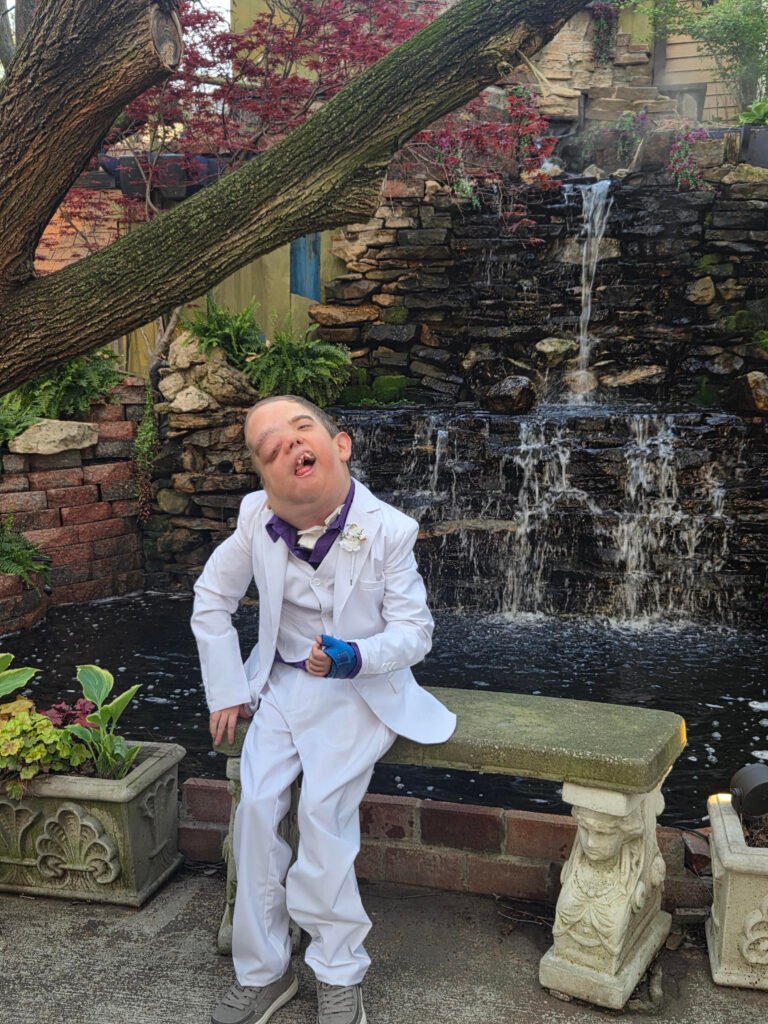
“He’s been on it since February 2016,” Fergus said. “The tumors have shrunk 35 percent, it’s now FDA-approved, and he’s doing great. He uses sign language to communicate, has a talker, walks in a walker, communicates very well although not using words. All the things they said he would never do.”
Looking back, Fergus said, “You don’t know you’re in the trenches until you get out and you realize, ‘Oh wow, that was not normal.” The couple had rotated four-hour night shifts to keep Frankie breathing. “Looking back, I can see that, yeah, that’s not normal. But we were doing what we needed to do to survive.”
Throughout Frankie’s early months, when they were in the hospital more than at home, they communicated with their then-10-year-old daughter via Skype, a fledgling technology at the time, and shuffled her among grandparents. Savannah had been excited about having a new baby brother, but it was a lot.
“You’re not just faced with a disability — we were prepared for that — but being handed a child with a terminal diagnosis at four months old is a completely different ballpark. We weren’t prepared for that.”
Healthcare Realities
“I can recall sitting in children’s emergency thinking, ‘I can’t lose my job because I need healthcare.’ And what a stress that was, to think that,” Fergus said.
“We’re still in that boat. People still face that, with diagnoses every day that have them asking, ‘how can I afford this treatment?’”
But Fergus notes another crucial issue in having to make such choices. When Frankie’s tumors appeared, no drugs were available. “Now, 16 years later, there are two FDA-approved drugs, and that’s an incredible change over the last 16 years,” she said. “But it also required an investment in healthcare research, and when we start taking those things away, like we did just recently with reducing that funding at a Federal level, that progress stops.”
Beyond the finances, the process of getting healthcare for Medicaid recipients is complex and difficult, with bureaucratic obstacles that, in Fergus’s opinion, are sometimes created specifically to make it hard for parents to access care they’re entitled to.
“My husband asks me why we’re doing something,” she said. “I tell him, ‘because they tell me we have to.’”
For example, because Frankie has weakness on one side, they treat him with Botox. To do this, they first visit a doctor, who agrees that Botox will help, a step they still have to take after years of using it. They then must return to him again to get formal agreement to seek authorization.
“And then we have to go back a third time and get it done,” she said. “To me that’s ridiculous. There are a lotta hoops you have to jump through with healthcare, a lot of appointments.” And, she noted, with a child with medical complexities, multiple doctors are involved, each requiring multiple visits.
Advice to Parents
Fergus stressed the importance of a support system — extended family, church, or at least someone to talk to, pray with, or vent to.
She wished folks knew more about how to get services. “People think that Frankie just automatically gets Medicaid because he’s disabled, and that’s not the case in Kansas,” she said. “He gets aid solely on the basis of financial means, and your income has to be extremely low to get on Medicaid.”
Instead, services come through Home and Community Based Service (HCBS) waivers, available for people in one of a handful of categories such as intellectual disabilities (IDD), frail elderly, autism, and — for Frankie — technical assistance (TA), which pays for his supplies, therapies, and a full-time nurse.
However, the Federal government mandates certain services for all states, which are covered in those that have expanded Medicaid. But Kansas has not expanded, and current Federal funding cutbacks are further squeezing the state, which has turned to cutting optional coverage services. Waiting lists for waivers are already long — those wanting IDD waivers must wait eight years — and Fergus is concerned that those with TA waivers might also soon have waiting lists. “We don’t have the option to wait. We live day to day, moment to moment.”
“Health care is so vital, so important, it should be a right of everyone,” Fergus said. “I wish everyone had it, not just in this country but everywhere. It impacts so many parts of our lives.”
###