
I Can’t Afford to Be Sick
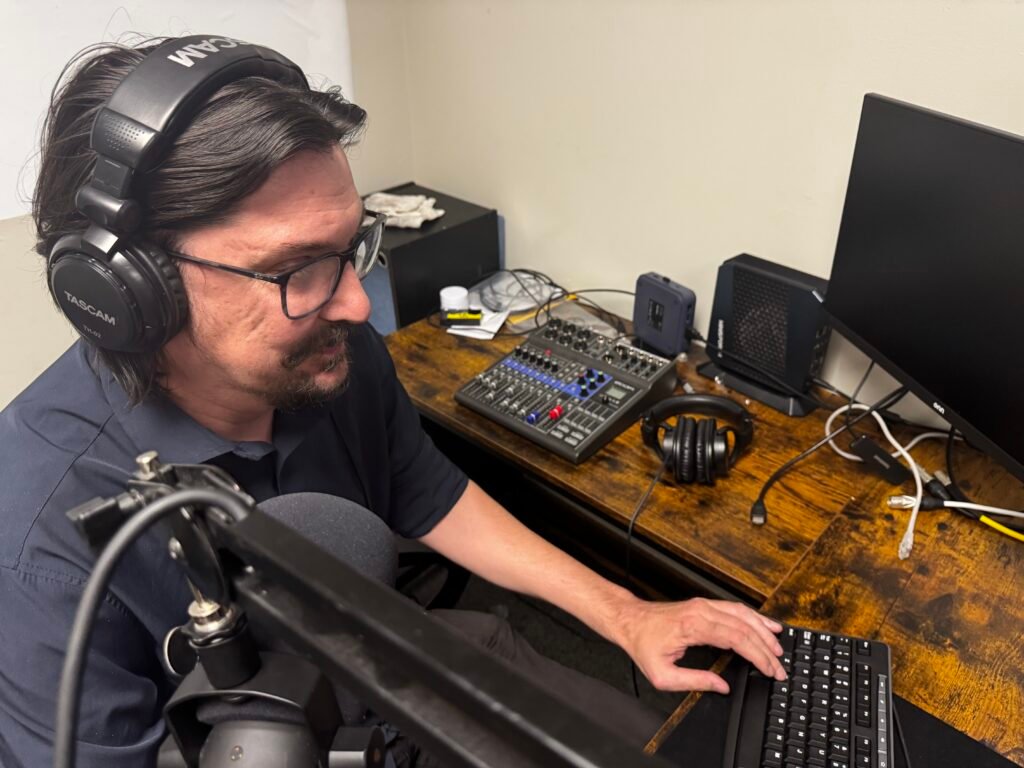
Christopher Acker doesn’t know a stranger. He recently worked as the program manager at Startup Hutch, runs his own podcast production company, Salt City Sound, and helps teach non-tech-savvy people how to use their iPhones and Kindle tablets. Soon, he’ll join the staff at the Hutchinson Public Library, joining its new MakerSpace that is currently under construction.

At 6-foot-6, Christopher is easy to see, which only adds to his identity as a friendly, community-minded person who’s always eager to help out however he can.
It’s much harder to see the rare medical condition underneath, which has shaped nearly every aspect of his life, including every job he’s held and every hour of leave he’s had to use.
Christopher’s height is due in part to Marfan syndrome, a genetic disorder of the body’s connective tissue that affects somewhere between one in 5,000 and one in 10,000 people, according to the Centers for Disease Control and Prevention. It’s caused by a mutation in the FBN1 gene that produces fibrillin, a protein that gives tissue its strength and elasticity, leaving it brittle instead. The same mutation also disrupts a growth-signaling pathway, which is part of why the condition often shows up as unusual height, a crowded jaw, or a chest that buckles outward instead of in. Acker has all three.
Complications from Marfan Syndrome can affect the blood vessels, heart, eyes, skin, lungs, and the bones of the hips, spine, feet, and rib cage. Three years ago, the connective tissue in his eyes gave out. Both lenses dislocated, and surgeons had to suture in artificial replacements.
The most dangerous risk, however, is the heightened risk of aneurysm.
In February 2011, at 20 years old, Acker felt a sudden, tearing chest pain. The inner layer of his aorta had torn, and blood was pushing between the layers of the vessel wall. Only the outermost layer held.
Surgeons operated within days, opening his chest and replacing the damaged section with an artificial aorta. Aortic dissection in Marfan syndrome usually shows up decades later, in a patient’s 40s or 50s. Acker was 20. His mother, who also had Marfan syndrome, wasn’t as fortunate – her aorta ruptured in a car accident, causing her death.
Now, annual CT scans of his aorta are non-negotiable, doctors tell him, though he can’t have an MRI because of the metal left in his sternum from surgery. He can’t lift weights, run sprints, or do anything that spikes his blood pressure. There’s no medication that treats Marfan syndrome directly. Blood pressure drugs help, but only to a point, and sometimes his blood pressure would drop dangerously low.
And some years, when the scan and tests weren’t affordable, he skipped it.
He was working the deli counter at Target when the dissection happened. He used up all of his sick leave for the surgery while he spent his time in recovery mostly unpaid.
Too Well for Help, Too Sick to Work
The aorta wasn’t the only thing working against him.
For years, Acker was treated for major depressive disorder, cycling through long depressive stretches that made ordinary life hard to manage. It wasn’t until 2020 that a clinician correctly diagnosed him with bipolar 2 disorder, a form that presents as long depressions punctuated by brief highs – which is frequently misdiagnosed as depression.
Getting on the right medication changed his life, but he’s also learned exactly how fragile that stability can be. A pharmacy supply disruption cut off his prescription for a stretch last year, and without it he was barely functional for weeks. Without a manufacturer discount card, the drug runs $1,500 a month, effectively out of his reach.
“I’m well enough to not get support, but sick enough that it can be challenging to hold a job,” Acker said.
His condition will likely worsen over time, but a doctor once told him not to bother applying for disability. He doesn’t fit neatly into either category, well or sick, and the space in between is where paid leave is supposed to catch people.
Too often, it doesn’t.
He’s lived that gap directly. During college, he thrived in campus leadership roles that matched his energy. When he took a help desk job in Wichita after graduation, he found himself struggling. His appointments piled up, both cardiac and psychiatric. In an effort to correct course, he used up his sick time, then his vacation time, and then took unpaid leave. Eventually, he was fired for excessive absences.
“There wasn’t really a choice for me,” he said. “I have to go to these appointments. I also have to work.” Losing that job felt like more than a paycheck. “It’s dehumanizing. It makes you question your self-worth. It makes it feel like society doesn’t value you.”
He isn’t alone in that gap. Nationally, only 56 percent of workers are even eligible for the unpaid leave protections in the Family and Medical Leave Act, according to the U.S. Department of Labor. Eligibility drops sharply for anyone earning less than $15 an hour.
Paid sick leave is more common than it used to be, covering roughly four in five private-sector workers as of last year, but Kansas has no state law requiring it. Whether an employee like Acker gets paid time off to manage a chronic illness depends entirely on where they work.
Not a Game of Luck
His previous employer, Startup Hutch, has been generous with leave and understanding about his mental health needs, especially during the medication shortage. Last year, for the first time, he took a vacation that wasn’t built around a medical appointment. He flew to Germany to visit family. Every day of paid time off before that had been used for medical appointments.
Acker doesn’t think that a person’s health and livelihood should depend on luck. He wants to see expanded and protected FMLA leave, Medicaid expansion in Kansas, and eventually a single-payer health system, paired with a broader shift in how society measures a person’s worth.
“I’ve learned your value isn’t based on your productivity,” he said. “There are people who value you for what you bring to the table as a person, not just what you can produce. Flexible leave is one of those things a job can offer that isn’t a paycheck.”
He thinks Hutchinson, and the country, are losing something by pushing people who can’t work a standard 40-hour week to the margins.
“Maybe if they could work 25 or 30 hours and still be present in their community, we wouldn’t lose them,” he said. “This isn’t a decision I made. I didn’t choose to be sick. I don’t choose to miss work. My hand is forced in those situations.”
The health insurance he depends on to manage both conditions is also what keeps him from taking a real risk on taking bigger steps with the business he’s built. He’d love to grow Salt City Sound into a full-time venture, adding clients and shows, maybe even launching a nonprofit that provides shared audio and video support to other local organizations that lack resources or technical expertise. That next step, though, would mean walking away from employer coverage he needs to stay alive.
“If it wasn’t for my need for insurance and paid leave,” he said, “I’d be a more innovative small business owner. Because of it, I’m not.”
Chronic illness, he points out, is often invisible. Nobody looking at him at a city council meeting or behind a podcast microphone would see the health risks he lives with every day.
“People aren’t lazy,” he said. “Especially people with both physical and mental illness. Everyone is trying as hard as they can.”
###