
Why Abortion Access Saves Lives: A Kansas Mother’s Story of Survival
When Elizabeth Ault, 41, speaks about reproductive health care in Kansas, she does so from lived experience. She understands firsthand how policy can enter uninvited into an exam room, inserting itself between patients, their doctors, and the hard decisions which must be made.
Born and raised in Topeka, she left Kansas for adventures abroad, including study, travel, and service. It was during her Peace Corps work that she met her husband, Luis, by chance at a bus stop in El Salvador. Today, twenty years later, the two of them are raising their family in Roeland Park, embracing a daily rhythm shaped by both of their cultures and the lively chaos of their “three amazing little humans.”
Elizabeth is an English as a Second Language teacher in the Shawnee Mission School District and a mom to two boys, ages 9 and 3, and a six-month-old baby girl. In her community, she is known as loud, outspoken, friendly, and relentlessly supportive. During her time in the Peace Corps, she learned that sustainability comes not from imposing solutions on people but from amplifying others’ strengths: “Really figuring out how to be people’s cheerleaders and how to push them forward.”
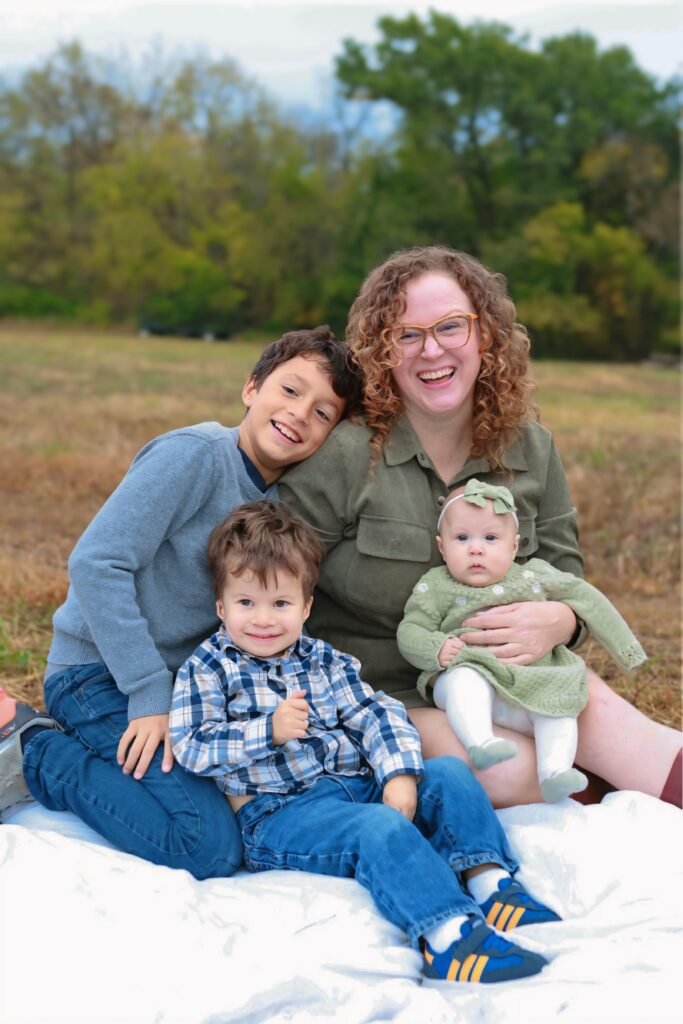
The values of independence and community anchor her identity as a teacher, as a mother, and as a Kansan. She explains that “those are kind of opposite of each other…[but] they work well together because when I can take care of my health, I can be independent, and I can [then] help others in my community.” They also shape why she speaks publicly about abortion access. Elizabeth has three children, but she has been pregnant six times. Her three life-threatening miscarriages underscore the story she believes Kansans need to hear.
When Policy Enters the Exam Room
Her first miscarriage took place during the Brownback administration, when her fetus was found to be nonviable; her doctor advised an immediate abortion. “There is no chance of this child surviving. The safest thing for you is to get an abortion,” he told her. But when she asked whether she could have the procedure there at KU Medical Center, she was told no. Policies shaped by the administration required her to be sent elsewhere. She remembers the feeling vividly: “I have to be handled like I’m an other. I’m an outsider.”
She was forced by state restrictions to leave her trusted doctor and established medical team and undergo the procedure in a clinic she had never even seen before. All this as she was processing the reality that her first pregnancy was going to end without a baby: “The whole vibe of being sent away. [I felt] hushed and pushed.” Once at the new clinic, she was required to undergo medically inaccurate counseling and unnecessary scans mandated by state law. She was handed pamphlets claiming abortions cause breast cancer— a claim long discredited by major medical associations. “For what purpose is this?” she remembers thinking. One doctor quietly tried to offer compassion, acknowledging the sham of the requirements as well as sharing her own fertility struggles. It created, she says, “an odd way to connect,” but it helped steady her at a difficult time.
The Difference Dignity Makes
Her next two miscarriages happened under the Kelly administration. The difference was stark. Elizabeth was allowed to remain with her medical team at KU. She recalls feeling treated as a welcomed patient and not as a problem to be relocated. “I didn’t feel othered,” she says. “I felt like a person having a medical issue, and this was the way to deal with it.”
The contrast between those experiences, she says, revealed how profoundly policy can shape care—and one’s feeling of dignity. All three miscarriages also outline the realities of abortion access and care. Any woman, at any stage of any pregnancy may find herself in a situation in which an abortion is medically necessary for her own health, fertility and life itself.
When “Abortion” Becomes a Lived Reality
What Elizabeth most wishes people understood about miscarriage and medically necessary abortion is the emotional landscape: the way the back of the baby book—the section listing the things that can go wrong—suddenly becomes your lived reality. Her first pregnancy ended in loss, followed by an urgent warning from her doctor: waiting for her body to miscarry naturally could threaten her future fertility. She needed a timely, safe procedure; however, politicians had decided they needed to be in the exam room with Elizabeth and her doctor. The Brownback administration created barriers to “just make it more difficult…just more hoops.”
“We’ve given that word ‘abortion’ a lot of connotations,” she says. “But it’s a medical term—something your body does or doesn’t do [needs or doesn’t need] when it should or shouldn’t.” The American College of Obstetricians and Gynecologists defines abortion as “a medical intervention provided to individuals who need to end the medical condition of pregnancy” and emphasizes the importance of clinically accurate, unbiased language. The layers of political narratives attached to the term often veer far from the lived medical realities unfolding every day across Kansas.
Survival Is Not Abstract
Elizabeth’s second miscarriage was the most dangerous. She had developed a partial molar pregnancy, a condition in which placental tissue becomes cancerous. She needed an abortion followed by chemotherapy. “If I hadn’t had that abortion, I could be dead,” she says. “I couldn’t have this conversation.” The term “medically necessary” is not abstract to her. It was about survival.
These experiences shape her frustration with lawmakers who continue to pursue abortion restrictions despite Kansans voting decisively, 59%-41%, to protect access in 2022. “We said no,” she emphasizes. “If someone says no, you stop. That’s consent.” Even the counties most supportive of restrictions have residents who voted to protect access. “Those people in those counties—they’re Kansans. They deserve to have an amazing life in this amazing state.”
When legislators persist anyway, she asks: “Why? To what end?” She believes many lawmakers only confront the consequences of their policies when a partner or daughter experiences a medical crisis themselves. No one should have to nearly die, she argues, for lawmakers to understand science, trust women, or believe doctors.
“There are a lot of laws about my body. But the people making the laws don’t have my body. They also don’t have the medical expertise needed to weigh risks, complications, and patient outcomes.”
Elizabeth is struck by the absurdity of singling out abortion for political regulation when countless medical procedures—root canals, colonoscopies, organ transplants—happen without public scrutiny. “There are a lot of laws about my body,” she says. “But the people making the laws don’t have my body. They also don’t have the medical expertise needed to weigh risks, complications, and patient outcomes.” Furthermore, she states: “I wish that they knew that their beliefs are not backed up by science…Their beliefs are very limiting to the human possibility.”
If lawmakers truly valued freedom, she argues, they would recognize that pregnancy carries risks that can unfold rapidly, and often unpredictably. She says, “A woman could be in the wrong state at the wrong time and could die,” because doctors may be forced to wait for legal clarity rather than provide care. Meanwhile, a man facing a medical emergency experience no such barrier. “Freedom for what? For whom?” she asks.
A Call to Kansans
She would not be the mother to her three precious children without the care that followed her medical emergencies. Pregnancy, she reminds Kansans, can be dangerous: “There’s a lot at that cellular level that you can’t control. Sometimes your body knows what to do, and sometimes it needs the help.”
When Kansans hear her story, Elizabeth hopes they take two actions.
First, she wants them to recognize the power of one informed conversation, an approach she learned in the Peace Corps. Change does not always begin with sweeping political campaigns. Tell the stories that make concrete what abstract policy debates mean for real families. “Sometimes it’s just talking to your neighbor,” she urges. “Maybe you change one person’s mind, and then they change someone else’s.”
Secondly, she wants people to stay engaged. Vote. Call representatives. Attend local meetings. “I wouldn’t be alive,” she says plainly, “without access to abortion.” She wants Kansans to remember they have a voice and that they should use it.
Elizabeth believes deeply in the Kansas she grew up in—a place full of community-oriented people who can hold independence and compassion at the same time. “We’re not flyover country,” she says. “We’re an amazing, beautiful, wonderful state with lots of hard working people.” She wants our state’s laws to reflect the values shared by Kansans: respect, accountability, and the belief that decisions about health should remain between patients and their doctors.
For her, abortion access is not political. It is human. It is medical. It is urgent.
“We need to talk about abortion for what it is,” she says. “A medical procedure done by trained medical professionals.” One that saved her life. One that allowed her to become a mother. One that Kansans overwhelmingly voted to protect.Her hope is simple: that leaders will finally listen to Kansans.
###