The Prairie Solution: Lydia Nebel and KC Farm School
“People know we need to protect forests and oceans, but so few know how important the prairie ecosystem has been for the entire world,” said Lydia Nebel, farm director of KC Farm School. “We’re a force for addressing climate change, and people don’t even know it. We just get told we’re the middle of nowhere, we should just bulldoze it, there’s nothing here, when in actuality for thousands of generations this has been an incredible place.”
KC Farm School sits on 14.5 acres of urban land in Kansas City, Kan., stewarding land called Gibbs Road Farm and Common Ground. The organization is a working regenerative production and education farm founded in 2018 by a teacher and a farmer to grow food and teach others to do the same.
Nebel leads the overall production, market and operations for the organization. Projects include volunteer field trips, weekly visits from students participating in the Farmers on the Rise apprenticeship, a community garden and tool lending library, the hosting of events like plant sales and Farm Fest, increasing community food access, supporting KC area farmers to connect, and integrating policy and advocacy work as often as possible.
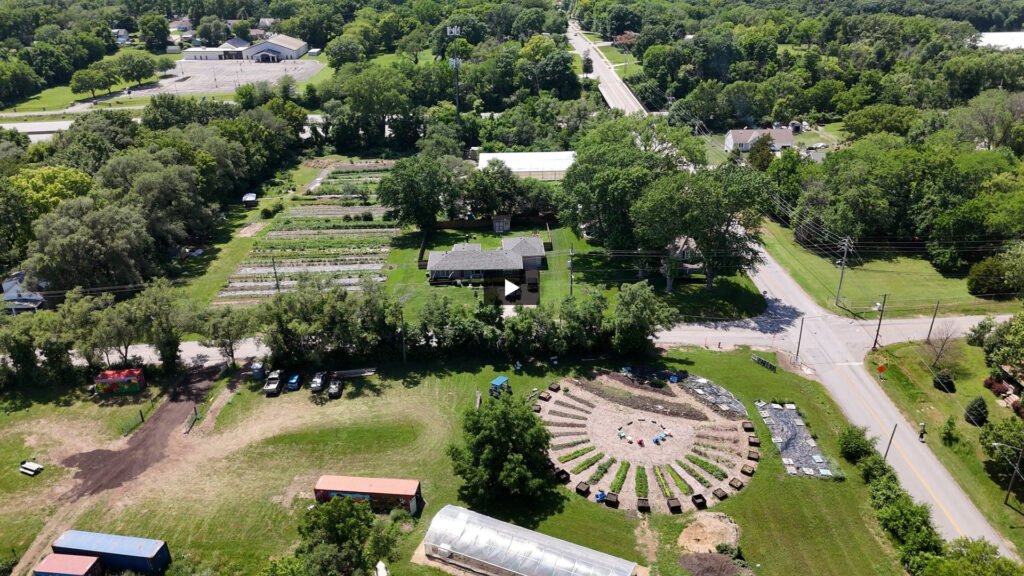
KC Farm School uses on-farm, hands-on learning — “kids understand better when they are looking at an elderberry plant” — and trains staff to work with rather than for their community.
Among many things, Nebel teaches about the ecosystem, its importance in the climate crisis and its losses of Native species and people — including their violent displacement.
KC Farm School personnel see the farm as the center of the community and Nebel sees her role as being “to bring folks into that.”
That includes training them in manual labor, ecosystem care, and understanding “regenerative agriculture that builds us up, draws us into more connections, all species, human and nonhuman,” she said.
She also does policy and advocacy work via the regional climate action group ReAmp Network, whose “north star” goal is “equitable carbon neutrality in the Midwest by 2050.”
Nebel said the issues it addresses affect everyone, especially urban farmers.
“I’m trying to bring in places most impacted by climate change but with the least say about it, like Wyandotte County,” she said.
She’s involved with the annual WEALTH Day in Topeka, helping to facilitate events like a youth panel and talks with legislators about how to bring Water, Energy, Air, Land, Transportation, and Health to all Kansans.
“The next generation is taking this seriously,” she said.
Plans for the farm’s future include a brick-and-mortar Earth and Sky School, slated to open in 2027.
We’ve Lost the Eyes to See
Nebel began farming after college.
“I realized I didn’t know where anything came from, from food to clothes to knickknacks, paper, who was producing it, how,” she said. “I stopped consuming anything new, [started] going to the farmers market, learning from old grumpy farmers how to make Swiss chard.”
She planned to go to law school and study labor and human rights, trafficking and exploitation in the food system. She met the farm manager at Gibbs Road Farm, then leased by Cultivate KC, applied for the crew and soon realized that “all the other things I wanted to change were addressed through farming and food production.”
“No matter what issues you are involved in: wealth disparity, segregation, housing insecurity, healthcare, education debt, gun violence — if we can get the folks involved in these areas to connect to their local food economy, all of them benefit,” she said. “People do better physically, so then mentally and emotionally, when they are eating seasonally and locally, because it’s more nutrient dense, it’s giving your body more of what it needs.”
She said connecting to local food also means people participate in their community rather than sending money for what they consume far away.
Nebel, who came from a conservative family in a small town, had thought she was “weird and out of place.” But when she met others in the farm’s community, she learned of a whole movement of people identifying that problems were coming from the industrialized food system.
She said, “The Great Plains is an efficient holder of carbon, and it evolved over thousands and thousands of years of human and nonhuman interaction, the Native nations interacting with this large-scale fertility going on through the migration of the buffalo and the elk and deer, and all the animals that came along with it. It’s an intimate ecosystem, and our soil is reflective of how we’re caring or not caring for it. We’ve lost the eyes to see how incredible it is.”
One Generation’s Losses
“Within one generation, we’ve gone from ‘I grew up on a farm’ to ‘this is the first farm I’ve seen,’” Nebel noted.
She said young people are eager to change that. At first, students arrive repelled by the down-and-dirty aspects of farm work, “but 45 minutes into it, they’re in the compost, leading the way, not worried about their clothes getting dirty, trying to teach each other stuff they learned 10 minutes ago. We have 12 chickens, and that is huge for the students — to see a real live chicken, the care and respect we give them.”
She described a group of students whose teacher folded a visit to the farm into the class curriculum. They walked through the farm, looking at what had been done but thinking about what they could do.
“They considered resources, watershed, profit; then they made a formal presentation,” she said. “They could’ve just gotten a grade, but they wanted to do this, were thinking through things, able to present themselves well, thinking about climate chaos, climate resilience, prairie, water quality in a suburban area. I taught them a little about those things, but they were the ones who were really excited about it.”
A Hard Road
Nebel said capitalism has set up a hard road for today’s farmers, especially those centered on crops for human consumption: “Farmers have to work so hard to make it financially in this country if they’re farming the food people eat every day.”
She said she’d like to see movement away from wealth disparity, from an economy that necessitates “haves” and “have-nots.”
“There’s a world where that is not the case, where farmers have access to education, healthcare, retirement, land,” she said. “We have just been policy-ing our way into a mess of farmers carrying way too much weight of society. It’s all those structural issues that make farming near impossible for a lot of people.”
Teaching young urbanites how to connect with the land is a big piece of Nebel’s work to change the future for farmers.
“Interacting with farming now impacts generations to come,” she said. “If we can get to a place more intentional and interdependent, with community-based economies, everyone would benefit.”
Be the Change
She encouraged others to work toward this change in varied ways.
“Think about the farmers, the people growing your food,” she said. “Every time you eat, someone somewhere has done that work for you.
“People want places like farms and markets to exist, but because of all the structural issues that weigh so heavy on people, they can’t quite figure out their consistent role in the local food economy.”
But Nebel insists that even for those who feel too busy, tired or uncertain about how to connect, there are always small ways to do so.
“Grow a garden surrounded by native plants,” she suggested. “Or donate to an organization. Or go to the same farmers market every week. Commit to spending 40 percent of the grocery budget at the local farmers market every week. Or, if they’re good at talking to people, they can advocate for equitable farm bills. Contact their representative; get a neighbor to attend a city council or board meeting. Talk to friends. And vote. All of us have a part in this.”